Wednesday, February 18, 2009

Feb. 18: Kyoto and Teramachi

Another day of early rising again saw us rushing to the train station to catch a JR line to Kyoto.  We stopped in the Kyoto train station to admire the arching architecture and the endless flights of escalators which ran all the way to the top.


Our first stop was Sanjusan Gendo, an old wooden temple housing a thousand statues of bodhisatva, or beings who had nearly reached enlightenment but who chose to remain just short of it in order to teach their fellow beings.  These bodhisatva were carved from wood and painted in gold, and although they seemed identical, closer inspection revealed that each one had an individual face and drape of clothing.  The central bodhisatva was Kannon, and the thousand golden statues stood alongside several large, dark wooden statues of characters in Hindu-Japanese mythology, such as the gods of thunder and the wind.


Sanjusan Gendo temple is also the site of the national archery contests, and Hurley Sensei described how archers would shoot down the length of the building, the arrows arching beneath the eaves of the temple porches to hit the target on the far side.  One archery event was seeing how many hits an archer could achieve in the space of 24 hours, and the reigning champion of this event, an unknown commoner in the sixteenth century, shot a total of 13,000 arrows in that amount of time (8,000 of which hit the target).

After buying some trinkets and fortunes at the Sanjusan Gendo temple gift shop, we headed for Kiyomizudera, the "Pure Water" temple in Kyoto.  The temple sits on the top of a large hill, on which sits many traditional wooden Japanese-style buildings; we passed these small, busy, beautiful buildings with delight and headed towards the temple.


Kiyomizudera is actually several buildings large with pathways connecting them together.  In the first building, we gawked at the fashionable Japanese young people with their super-hip J-Pop outfits and hair, standing around a giant bowl of incense.


Then we noticed that other Japanese young women were in full kimono dress, beautiful vibrantly colored floral prints with their hair elegantly styled, walking on the traditional Japanese wooden tori.  Mrs. Shiokawa, a friend of Hurley Sensei's who accompanied us on our tour of Kyoto, explained that Kyoto is a kimono fabric manufacturing district, and young women can rent kimono to feel lovely and advertise wares.


In the Buddhist temple was also a Shinto shrine, which Hurley Sensei said is fairly common.  This shrine was dedicated to love, so many young people -- including our students -- entered enthusiastically.


Stands lining the walkways sold charms to bring good luck in finding love or strengthening a relationship.  One of our students bowed and shook a long red banner to ring a golden bell in front of a shrine to bring luck in love.  Other students walked, eyes closed, from one "love rock" to the other, with some help and directions from their friends.  When they managed to reach the other rock, the crowd of people around them clapped.


Sitting near the temple's central attraction, a structure where the "pure waters" spouted from the mountain over the roof of the structure and into a pond.  We ate steaming bowls of udon with sweet fried tofu and watched as the Japanese people collected this water in cups, washed their fingertips, and drank a sip to bring the granting of a wish.


Leaving the temple, we walked through the curving streets of old Kyoto, through the old-style Japanese buildings.  Busy shops lined the streets selling ice cream, crepes, mochi, or souveniers.


Reaching the bottom of the hill was like walking out of a time warp: the old fashioned wooden buildings again became a modern Japanese city bus stop.  Worried about spending too much money, we decided to forego bus fare and instead walk to the manga museum, our next stop.  About three miles of brisk walking and sightseeing through Kyoto's modern streets brought us panting and tired to the steps of the manga museum, but we were disappointed to see that it was closed on Wednesdays.  We hopped on a subway and headed for Teramachi, the shopping district.


One of the students pointed out that all of the streets in Teramachi were labeled "Shopping Street," and we were not disappointed.  Wide pedestrian walkways were crowded on both sides with shops and cafe's selling everything and anything.  Hurley Sensei gave us a few hours to walk around, so we set off in different directions.  Some of us sat in a coffee or donut shop, resting after our long, brisk walk through Kyoto.  Some of us headed for karaoke singing and were thrilled to find musical theater selections.  Others of us shopped for clothing yet again.

Once again tired from our adventures, we met at our appointed place and time and headed from Teramachi back to the Kyoto station.  We spent some time eating and exploring the architecture once more, then hopped on a train back to the Shin-Osaka Youth Hostel.  Once again exhausted, we all quickly fell asleep.

Tuesday, February 17, 2009

Feb. 17: Mt. Koyasan Area, Umeda, and Namba

We awoke early the next morning in order to attend the chanting ceremony of the monks.  Rushing to wash our faces in the freezing morning, we stopped short when we reached the outer corridors and found snow on the ground.  The temperature had dropped overnight to below freezing, so we were all grateful that we had packed our long underwear and scarves.


The monks chanted in a small, dimly lit room with crimson walls; tall, ornate lanterns; and huge figures of Buddhist saints painted on the walls.  We sat on the floor in front of the raised dais where the monks sat, breathing in the heavy incense in the air and shivering a bit from the cold.  The ceremony was amazing -- the monks chanted for about 45 minutes without stop, and most of them did not have any books or references beyond their own memory.  At one point in the chanting, the one native Japanese man watching the ceremony knelt before the pot of incense burning in front of the dais, bowed, added a pinch of incense to the pot, and bowed again.  He then motioned for one of our students to follow his lead.  Proudly we watched as our Wilcox student followed his lead, and eventually almost every student participated in the ceremony.


Upon leaving the ceremonial room, we were greeted with one of the most beautiful sights on the trip: a courtyard where the trees, sand patterns, rock sculptures, and rooftops were covered with snow.  The sun had risen while we were in the ceremonial room, so the new light reflected brightly off of the flakes of white falling softly from the sky.


We ate a quick breakfast again on two rows of trays in the eating hall, packed our bags, and said good-bye to our gracious host.  Then we were off to explore the town on top of Koyasan.  Our first stop was a square with several old wooden Japanese temples.  Our students splashed the cold temple water on their fingers in a ritual cleansing -- water so cold that it hung in icicles on the cup utensils.


Then we visited the largest temple, a huge orange structure.  A television camera met us at this temple, taping our rounds of the sites and occasionally asking our students to say a few words in Japanese, which they accomplished admirably well.  We entered the huge orange temple, looked around at the large statues of Buddha, and then rubbed spices on our hands as we left.


Our next stop was a tour of the cemetery at Koya, the largest in Japan with an estimated 200,000-500,000 graves.  This is a sacred site because it is nearby the cave where Kobo Daishi is said to be still sitting in a cave in meditation, praying for the world.  We spent a long time meandering through these graves, seeing such dignitaries as Toyotomi Hideoshi and Oda Nobunaga, two major figures in the civil war period before the Tokugawa shogunate.


We saw a well about which our tour guide said, "If you look in this well and do not see your face, you will die within three years;" luckily we could all see our faces.

We also saw a wishing-box: a large, sturdy wooden box with a hole big enough for one arm to enter.  In the box was a higher platform, a lower platform, and a large rock; if you could lift the rock with one hand from the lower platform to the higher one, your wish would come true (one of our young ladies was able to lift the rock, much to the chagrin of the rest of the group who was not able to lift it).

Finally we reached the shrine at the gates of the pathway leading to the cave in which Kobo Daishi sits.  We stopped for a few moments in contemplation, then started back the long walk to the cemetery entrance.  As we were walking back, snow began falling again, drifting onto our jackets and hair.

Coming out of the cold snow and long walk of the cemetery, we found a nearby ramen noodle shop, a real godsend out of the damp cold.  These noodles were probably the best we had ever tasted right after walking through the icy cemetery paths.  After warming up for a bit, we again hopped on a series of trains that took us back to Osaka.


After a little time settling down in our beautiful, clean youth hostel rooms, we again headed out for Umeda.  The main attraction at Umeda was a giant shopping mall with a huge red Ferris wheel at the top of the building.


Some of us spent some time quietly taking in the sights of busy, crowded, neon Umeda from this great height.


Others immediately began shopping in the six stories of stores.  A third group headed out towards the huge Pokemon store nearby.  When we met again a couple of hours later, everyone was happy, especially the Pokemon group, who arrived carrying huge bags of Pokemon plush toys.

Then we were off to Namba, another part of Osaka crowded with neon letters and brightly lit signs.


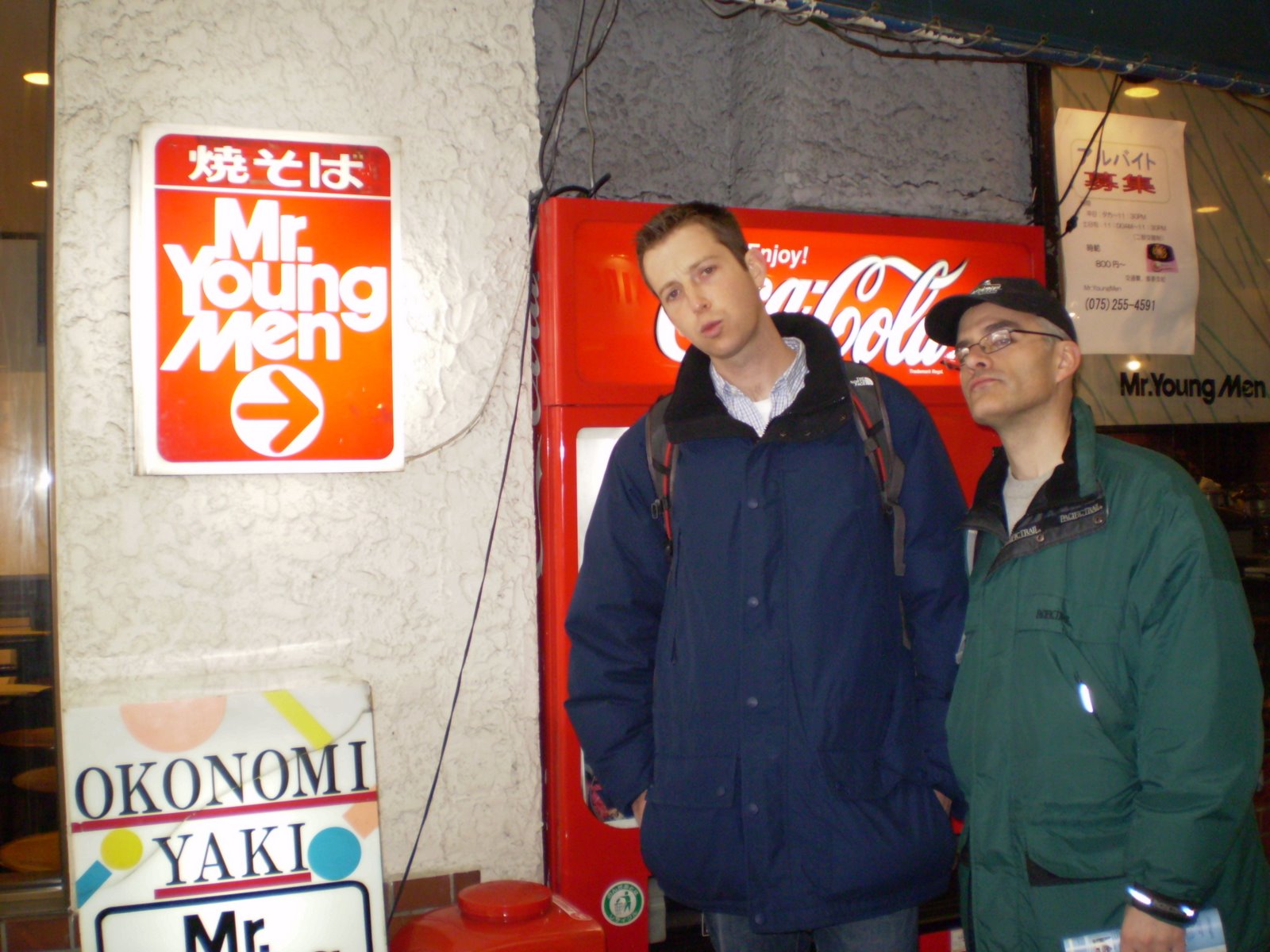
Although we were given free time to choose our dinner, most of us followed Will and Hurley Sensei to eat okonomiyaki, a kind of Japanese pizza made of a fried noodle pattie with delicious toppings on a hot plate.


Happy and full, we returned to the hostel and went to sleep.